- Американска и канадска художествена литература
- Антикварни книги
- Антични автори
- Балканска художествена литература
- Библиофилски издания
- Биология
- Българска художествена литература
- География, пътеводители
- Детска литература
- Европейска художествена литература
- Езикознание, лингвистика, семиотика, филология
- Езотерика, духовни учения
- Здравна и медицинска литература
- Земеделие и животновъдство
- Изкуство
- Икономическа литература
- История
- Календари, сувенири
- Компютърна литература
- Кулинарна литература
- Културология, етнология и фолклор
- Латиноамериканска художествена литература
- Литературна критика
- Литературна периодика
- Медии и комуникации
- Нобелова награда за литература
- Политология
- Правна литература
- Православна литература
- Психология
- Речници, справочници, енциклопедии
- Социология
- Спорт, хоби
- Точни науки, техника
- Учебна литература, Педагогика
- Философия
- Художествена литература от Азия, Африка и Австралия
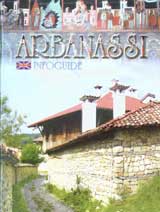
Infoguide Arbanassi
Продуктов номер: 17409Изчерпана
Автор: Колектив
Категория: География, пътеводители
Издателство: ДАР-РХ
Състояние: Нова книга
ISBN: 9789549489187
16 страници
меки корици
Първо издание: 2008
Народност: бразилска
At the end of the 15th century, when the glory of the capital city of Tarnovgrad was declining, as it seemed forever, a new cultural centre was coming to life in its close proximity - the village of Arbanassi, which was destined to preserve and promote the Christian culture during the long centuries of the Turkish yoke. The village of Arbanassi is situated almost at the centre of a densely populated region, formed between the towns of Veliko Tarnovo, Gorna Oryahovitsa and Lyaskovets, at about a four-kilometre distance from each of them. It is built on a high plateau, providing a panoramic view towards the mediaeval fortresses of Tsarevets and Trapezitsa, and the ancient capital of Tarnovgrad. The settlement has existed even at the times of the Second Bulgarian Kingdom, when it has played host to the summer residences of the boyars. The legend has it that there has been rising the enormous building, housing the mint yard of the Tarnovgrad kings. After the glorious victory of Tsar Ivan Assen II near Klokotnitsa in 1230, the Arbanassi land becomes a part of the Bulgarian Kingdom. The region of the capital has been gradually inhabited by immigrants from these outer regions, as well as by Bulgarian boyars from the most western parts - it has been them, in fact, who “brought” the name of the village. Another legendary tale narrates about a second, much later migration (15th c.) of cattle traders -Bulgarians and Christian Albanians from Kostur, South Albania and Northern Epirus. In the course of their frequent travels to sell their merchandise as far as the banks of the Danube and to its opposite side - the land of the Wallachs, they have finally decided to settle in Arbanassi. During the centuries of the migration processes in 15th—17th c. the Bulgarian territory becomes a host to a total of 50 Albanian villages, 10 of which has the same name. The royal decree of Sultan Syuleiman I the Lawmaker from 1538 presents the village as a gift to his son-in-law Rustem Pasha - Grand Vizier of the Ottoman Empire. From 1582 onwards its inhabitants are put under the obligation to guard the nearby mountain pass in exchange for numerous tax alleviations and privileges. Some of them are even granted the right of free citizens of the Empire, on a par with the ruling Muslims. Arbanassi becomes a large settlement with prosperous inhabitants from various nationalities: Bulgarians, Greeks, Albanians. Its merchants trade with cattle, meat, leather, diary products, copper, soap, tallow candles and many other articles. They travel to every part of the Turkish Empire, as well as to Romania, Hungary, Poland, the Moscow Kingdom, and even to such faraway places as Baghdad, India and Persia. The crafts are among the usual occupation of the population, too. The wealth and the international connections of Arbanassi soon transform it into a centre of the Christian culture of the Balkan countries. An ancient Bulgarian folk song commends its glory thus: "Arbanassi - you praiseworthy and illustrious village, you shine like a mirror of Bulgaria!" At the end of the 18th century the village was devastated, robbed and put on fire by various Turkish gangs of bandits, proliferating at the times. There followed catastrophic earthquakes and plagues, which forced the Arbanassi population to leave their homes and to seek more comfortable and safer places for living. Since 1810 Arbanassi has been gradually coming to life, being inhabited by immigrants from the Elena and Tryavna regions of the Balkan, but still remains in the shadow of the reviving Tarnovo. The numerous residential and religious buildings, preserved today, as well as the well-kept traditions and customs of the old inhabitants, perpetuate the shining glory of the village of Arbanassi even to the present day.